I stayed up until 1:30 a.m. last night reading Swimming to Antarctica: Tales of a Long-Distance Swimmer by Lynne Cox. By page 134, Lynne was 18 and had swum the English Channel twice, and breaking the world record both times.
This I have learned. The English Channel is really, really cold. Also, depending on the currents, the swim can be 30+ miles. And it seems to me that she trained about six hours a day.
Now, she did break the world record, and that definitely wasn't part of my "swim the English Channel by 40" objective. I was going more for "make it across."
Well, I'll keep reading. And find an intermediate goal, maybe something close by and a bit shorter.
And I'll definitely get into the pool today.
Tuesday, October 17, 2006


Thursday, October 12, 2006
swimming the english channel
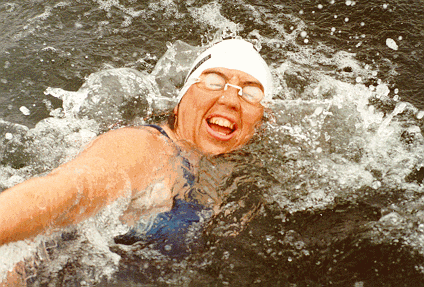 The English Channel is 21 miles wide. However, the hardy individuals who swim across the English Channel rarely swim only 21 miles because there are currents to consider and it's a major shipping thru-way, and then there is the weather...
Why do I know these interesting facts?
I got my pool membership today, and I’m drawn and drawn again to swimming, and to water. I can’t wait to get into the water. So of course, I think, why don’t I swim the English Channel? Isn’t that what anyone would think? Or is it this kind of thinking that makes me special/insane?
So I google “swim ‘English Channel.” Another interesting fact: most of the women who swim the English Channel are definitely – well, they are curvy, zaftig, however you want to put it. Bottom line: they have some weight on them, which (and this is very important) keeps them warm. From the photographs I’ve seen, this is not a sport for skinny people. Do you know that woman named Alison Streeter (that's her, in the photo above) holds the world record for channel crossings (43 and counting, including a triple crossing). Alison looks like a very nice person. Rather than giving the air of a super human athlete, she seems, well, down-to-earth, very much like she might get up in the morning and say, let’s go swim the English Channel again today -- wanna join me?
Back to earth. Two goals: start swimming 3-5 days a week, at least a half mile each day. And for the “Documenting the Sacred” class I’m teaching, commit to polishing at least three essays around the idea of spiritulity and water.
And if I do that, look into open water swims for this spring/summer.
Maybe I'll swim the English Channel by the time I’m 40. I feel a little foolish and audacious, but what the hell – it’s my birthday. And wouldn’t it be fun if it happened?
p.s. I’m also going to purchase Lynne Cox’s Swimming to Antarctica, because outlandish goals require new books.
na na na na na na today is my birthday...
and though not completely free of the funk of my last post, I'm having a good day. Lovely breakfast with mom & dad, lovely cake and singing from work-folks, lovely wishes and flowers and presents...and phone calls with good wishes.
and then out tonight on a surprise birth-day-date with L., and then we go to my folk's house on Friday for my favorite supper (chuck steak) and homemade mocha cake (thanks Oma!).
Then a weekend with no plans. It's kind of an amazing feeling. Who knows what I'll do! Or not do.
I'm grateful, grateful, grateful. For family, friends, a home, a sense of dark humor, for sustenance. I’m a lucky bird.
So thank-you, you, if you are reading this message. If I know you, thanks for all you bring to my life. And, um, if I haven’t called you in a while, I will. I really want to get together. Soon. More then likely, I miss you. It’s just that my priorities have been out of whack and I’ve been fighting a blue mood, and, and – well, I miss you. Y’all know who you are.
Maybe birthdays could be kind of like the day when the library lets you bring your books back without paying a fine? And you could let me back into your life even though I haven’t returned your phone call/email/etc.?
Not sure how all that came up.
Happy Birthday to me…and many more.
and then out tonight on a surprise birth-day-date with L., and then we go to my folk's house on Friday for my favorite supper (chuck steak) and homemade mocha cake (thanks Oma!).
Then a weekend with no plans. It's kind of an amazing feeling. Who knows what I'll do! Or not do.
I'm grateful, grateful, grateful. For family, friends, a home, a sense of dark humor, for sustenance. I’m a lucky bird.
So thank-you, you, if you are reading this message. If I know you, thanks for all you bring to my life. And, um, if I haven’t called you in a while, I will. I really want to get together. Soon. More then likely, I miss you. It’s just that my priorities have been out of whack and I’ve been fighting a blue mood, and, and – well, I miss you. Y’all know who you are.
Maybe birthdays could be kind of like the day when the library lets you bring your books back without paying a fine? And you could let me back into your life even though I haven’t returned your phone call/email/etc.?
Not sure how all that came up.
Happy Birthday to me…and many more.
Tuesday, October 10, 2006
i hate everyone

I can't quite stand films about shiny people -- for me, Meg Ryan personifies shiny -- who go through predictable, narratively simple life struggles that end in happy resolutions.
So of course, I loved Little Miss Sunshine.
I saw Little Miss Sunshine a couple of weeks ago, and the film satisfied me in deep ways. It was funny, sad, well-written, well acted -- I could go on and on. Most importantly, films about broken people who find hope make up my favorite genre. And when I say broken, I don't mean broken, like a horse is broken -- I mean people with visible fissures, messy people, people who don't have "it" together, whatever "it" is. I mean, of course, people like me, who couldn't pull "it" off even if I wanted to. Okay, I do want to, sometimes. Perhaps I could handle a little less of the delightful process of self-growth, the endless breaking down and building up of spirit and personality.
If you haven't seen the film, you can get the plot summary here, but essentially, the film is about the Hoover's, one of "the most endearingly fractured families in recent cinema history." And one of the characters is Dwayne, a Nietzsche lovin' teenager who has taken a vow of silence. He occasionally uses language by writing sparse words on a notepad. At a point in the film, he writes I HATE EVERYONE. When his Uncle Frank asks, "even your family?"Dwayne underlines EVERYONE twice.
Now, I do not hate everyone. I do not, especially, hate my family. But the sentiment connected with me in some way -- enough that I searched for a movie poster online, enough that I printed a copy and hung it up in my home office.
I'm not exactly sure why I'm drawn to the sentiment of "I HATE EVERYONE," but I’m beginning to wonder if morose is some essential part of my personality, if I’m kidding myself that I can become an integrated, spiritual person with joy in my (god damn) heart. If so, I certainly haven’t honored morose over these many years of my life. (I just looked up morose, to check and make sure it was the word I’m searching for, and it does work – “having a sullen or gloomy disposition".) Is it possible, that while fighting depression for more than a decade, I’ve demonized my sullen and gloomy side?
And how have I compensated for that demonization? I married a really angry person who did hate everyone. G. has a cute saying -- the difference between you and me is that you like people and I don’t. I found it charming. I was also pleased that someone who so evidently didn’t like people was in love with me. It made me feel special. Let’s not delve into that too deeply, shall we?
Since I wisely left that relationship, I’ve found other angry people to admire (and a kind, loving, and witty L. to date). My new credo: watch the angry people on television, but don’t date them. I’m drawn to really bitter comedians like Lewis Black, for example. To the understated expression of disbelief and outrage of The Daily Show. And of course, I adore Southpark – in whose anger, biting wit, satire, and refusal to hold back about anything I find a deep, satisfying release.
More times than I can count, when people have learned that I struggle with depression, I’ve been met with flat-out disbelief – occasionally shifting to an out-right refusal to believe me. “You’re so cheerful, so outgoing, etc. etc.” I still remember what a rather bitter goth chick wrote in my senior high yearbook – essentially, “you continue to smile as the world falls down around you.” Obviously, it was not a compliment. And even then, I sighed at the enormous gap between my public self and how I felt inside.
My hopeful, cheerful, outgoing self is real. I don’t feel like I’m “faking it.” But clearly, some part of that identity is an overcompensation for my depression. And I think my tendency towards depression has made me overly wary of my morose self. It’s scary to experience negative feelings when I don’t know if I’m having a genuine feeling or if the scales are tipping towards weeks or months when I struggle to get out of bed (note: “morning” and “morose” are in the same column in the dictionary).
And let’s face it, I want everyone to like me. Mostly everyone. I’m no saint – I do sarcasm pretty well. But I’m afraid a lot. My depression makes me vulnerable. I could (and do) screw up at any time. So I better dance, dance, dance while the going is good.
I do like people, especially people who are broken and not afraid to show it. Liking people makes it hard for me to be political on a large scale – I do better with relationships, dialogue, microcosm stuff.
I think mostly, I’m tired. I’m so tired I could weep. Taking a vow of silence sounds good to me. Alas, I am a professional extrovert.
It’s my 36th birthday this week, and I’m singularly unexcited. More trying, more trying, more trying. I know I’m not alone in being tired. I know I’m not alone in wanting peace. I know my mental illness doesn’t make me special, that suffering is perhaps the most egalitarian state of being.
Maybe I just want to hang out in morose for a while. Maybe I just want to know what morose would be like in public. What would happen if I let go of being so damn happy? What if I didn’t shove down anger, if I called people on their shit more often? What if I didn’t go so far as to hate everyone, but tried hating a few people, and what if (and this is a revolutionary thought) I went ahead experienced what it's like for a few people to hate me?
If you hate me and you are reading this, send me an email. I promise not to try to convince you to like me. Ok, I promise I’ll try not to try to convince you to like me.
Saturday, September 09, 2006
i love my family
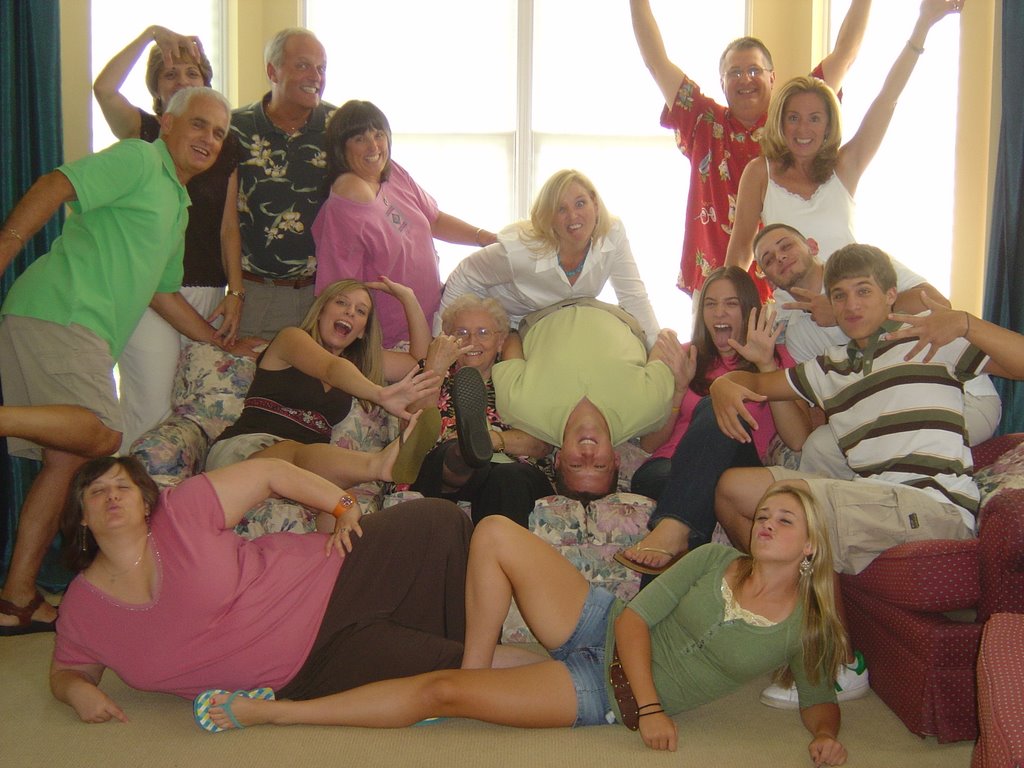
Yesterday was my grandmother's 80th birthday. We call her Oma -- growing up it was Oma and Poppop, Oma and Poppop. Poppop (Oma’s husband) died seven years ago, but he was with us today, in spirit -- I have no doubt about it. Nothing was more important to him than family, and for Oma, the biggest gift we could give her was all of us together. We (my mom, dad, Oma, and I) drove from North Carolina to New Jersey; my brother and his new wife flew in from California. My mom's two brothers and their families were here too -- all Oma's children, their spouses, and grandchildren.
I can hear my family downstairs -- my parents, aunts, uncles, cousins. I can hear my Aunt Shirley laugh and someone is singing -- actually, several people are singing. Two TVs are on – cars race around a track on the big TV, and in the kitchen, chairs circle around a tiny TV playing a home decorating channel. I want to write about all I'm feeling in this moment, but i also want to go back downstairs and join everyone, be part of the noise, the semi-chaos, the energy.
So for now, I'll just say this: I'm grateful, grateful, grateful. I'm grateful that we all love each other so much, and perhaps more importantly, how much we like each other. I'm grateful that we all give good hugs. I'm grateful for the beautiful day, for how loud we are, for how accepted and loved I feel. The way we go back and forth, sarcastic, loving, funny, loud. I know I keep saying loud, but people are generally much quieter in the south. I don't mind it so much, but I'm aware of how much free-er I feel to be myself. It's like traveling to the home of my ancestors, speaking my mother tongue. Something in me relaxes and feels right, in a way that I don't quite feel otherwise, even though I've lived in the South for 28 of my 35 (almost 36) years and consider it home.
Not knowing when we would all be together again, Oma wanted us to take a group picture. I came downstairs all showered and clean, and I said, "Look, let's take the picture before I either get sweaty or spill food on myself." I told that joke several times and each time, a different family member laughed. (Telling jokes and stories over and over again seems to be a common family trait.) They laughed because it's true, though everyone also agreed it was a good idea.
There were several artistic directors for this photoshoot -- lots of ideas for how to fit fifteen people in the picture. We were laughing from the beginning -- Morgan, a sophmore in highschool, posing on a faux bearskin rug, plus all the adjustments it took to make it work, not to mention all the opinions that needed to be considered. We took three nice pictures, everyone smiling, and then Morgan and I posed as models on the floor. Everyone joined in, and the resulting photo is posted here.
This photo turned out to be Oma's favorite picture. Morgan said it best, and often, sort of laughing, but utterly serious -- "I love my family." I'm not sure everyone would get us, but we definitely get each other.
Tuesday, August 29, 2006
stuck
I'm painfully, ruthlessly, stuck.
The hubhub of the summer is over (the summer is over? how did that happen?) and I happily anticipated shifting into a regular schedule and approaching life in a measured way, with my goals of moving towards wellness (including sleep, healthy eating, exercise), nurturing relationships, and making time for creative acts at the top of my list of things to do. Also, I looked forward to creating a clean, orderly environment, with a clean house and organized home and work offices.
Who was I kidding?
Unless I suddenly and completely transformed overnight into some completely different person, achieving the above objectives were extremely unlikely.
That last sentence was NOT self deprecating. Actually, as I wrote it, I felt a resounding sense of TRUTH. The goals I set for myself, hoping to build on the "back to school" impetus, were unrealistic. Not ultimately unrealistic -- they are certainly good goals to have, but the changes are not going to happen overnight.
Well, that's depressing, but also a relief.
I've been hiding the last few days, filled with paralyzing anxiety, unwilling to face the world.
I guess the painful, semi-hopeful, mortifyingly slow process of change is preferable to existing in a hallucination where it is indeed possible to transform overnight. Especially when the hallucination isn’t an innocent one – it’s poison, I tell you, poison.
The hubhub of the summer is over (the summer is over? how did that happen?) and I happily anticipated shifting into a regular schedule and approaching life in a measured way, with my goals of moving towards wellness (including sleep, healthy eating, exercise), nurturing relationships, and making time for creative acts at the top of my list of things to do. Also, I looked forward to creating a clean, orderly environment, with a clean house and organized home and work offices.
Who was I kidding?
Unless I suddenly and completely transformed overnight into some completely different person, achieving the above objectives were extremely unlikely.
That last sentence was NOT self deprecating. Actually, as I wrote it, I felt a resounding sense of TRUTH. The goals I set for myself, hoping to build on the "back to school" impetus, were unrealistic. Not ultimately unrealistic -- they are certainly good goals to have, but the changes are not going to happen overnight.
Well, that's depressing, but also a relief.
I've been hiding the last few days, filled with paralyzing anxiety, unwilling to face the world.
I guess the painful, semi-hopeful, mortifyingly slow process of change is preferable to existing in a hallucination where it is indeed possible to transform overnight. Especially when the hallucination isn’t an innocent one – it’s poison, I tell you, poison.
Tuesday, August 15, 2006
it must be fate...
One last thing...
Target is a sponsor for Weekend America! For those of you who know me & my Target obsession -- um, I mean, how much I enjoy my Target shopping experience, you'll recognize that this is definitely a sign.
Target is a sponsor for Weekend America! For those of you who know me & my Target obsession -- um, I mean, how much I enjoy my Target shopping experience, you'll recognize that this is definitely a sign.
letting be, making space, filling up
Since I'm on the topic of the "Our New Orleans" course (see earlier post) I'm recycling a piece of writing I did after one of the classes. Enjoy.
May 16, 2006
Many of you know that the "Our New Orleans" class I've been teaching for the last five weeks has been a sacred experience -- from my collaboration with Pam Broom, to the Katrina neighbors who agreed to participate, and the way that each element of the class that I have trusted to work out has indeed, worked out.
Tonight, I showed up to teach my "Our New Orleans" class empty, shaken, and tired.
I sat there next to my co-teacher Pam and thought that I should say something to get started -- I wrote down the things "to do" in class today, and then still, I didn't say anything as the participants in the class spoke to each other. I thought Pam might say something, but she didn't.
About ten minutes later, Nana, one of the participants from New Orleans, walked in with a white plastic grocery bag and a plant in a turquoise ceramic pot. Nana is a priest -- she trained for the priesthood in Cuba. She had prayed for us this morning at the Eno River, and she had received the message that she should present an altar for this evening's class.
So she set out a simple navy cloth napkin on the table, and April filled a clear glass bowl with water. She poured essential oils into a burner (one of those ones that are heated by a tea light) and it was a fresh, clean smell -- nothing heavy or muddying. She told us that all the elements of the earth were there on the altar -- pebbles from the river in the plant (minerals), the earth, water, etc. She invited us to each place an object onto the altar if we felt comfortable doing so. I placed both of my rings -- one from my parents, and one I bought in California as a reminder of the writer Amanda Davis, who I interviewed three days before she died in a terrible plane crash with her parents. Others stood up too, and place rings and necklaces, and one woman placed a flash drive with her photographs stored on it. We all shared stories about our sacred objects.
The "theme" of this evening's class was spirit, and almost as an afterthought, I had given the class Anne Lamott's essay "Traveling Mercies" to read, and a poem that serves as the epigraph to the book Traveling Mercies,” one that begins:
Listen
with the night falling we are saying thank-you
we are stopping on the bridges to bow from the railings
we are running out of the glass rooms with our
with our mouths full of food to look at the sky
and say thank-you
So I suggested that we each read a few lines of the poem, and I began. We went around the class, everyone reading a line or two or three -- it was up to each person. And Pam, who was sitting to my left, read the last line.
We all looked at each other, and Hei-Yesh (Pam’s daughter, and a writer/filmmaker) said what we were all thinking -- there were the exact number of lines for everyone to be able to read a part.
And the Anne Lamott essay, which I almost didn't give the class, turned out to be really important. I wasn't sure that students would want to discuss it, as it was only tangentially related to documentary work. But when I asked the class what they wanted to do today (by then I'd realized that I was thankfully not in charge), they wanted to talk about it. One of our Katrina neighbors told us she cried as she read it in the airport on the way to New Orleans for her graduation from Tulane (with a master's degree in environmental engineering). Another woman told the story of her mother's death; there were so many stories. Women told about how they grew up with the phrase "traveling mercies," in their families, in their church.
One of the things Anne talks about in the essay is how that when a lot of small and large things begin to go wrong, "it is to protect something that is big and lovely that is trying to get itself born -- and that something needs for you to be distracted so that it can be born as perfectly as possible." And how easy it is to believe that when it's other people's stuff that is going wrong, but when, as Anne says, "it's my stuff, I believe the direct cause is my bad character."
Anyway, in the essay Anne is driving to visit a childhood friend and her mother (who is very sick and close to dying) and a bolt loosens in her Volkswagen on her way over. She is unable to visit that day, but when she arrives several days later, she is able to be present for her friend and her mother, and she writes:
"Now, maybe you think it is arrogant or self-centered or ridiculous for me to believe that God bothered to wiggle a cheap bolt out of my new used car because he or she needed to keep me away for a few days until just the moment when my old friend most needed me to help her mother moved into whatever comes next. Maybe nothing conscious helped stall me so that I would be there when I could be most useful. Or maybe it did. I'll never know for sure. And anyway, it doesn't really matter."
Nana read this passage aloud to the class. And she said that it did matter. That our culture has gotten so far away from the beliefs about how the spirit works in our lives, as an active and present force, and that this belief is common to many cultures. That we need to understand that "life moves in a divine order."
I know I feel that way about meeting Pam, about the class, about it's participants -- I've felt that way from the beginning. There are times I feel that with certainty. And lots of the class participants felt that way too.
We have to move slower, Nana said. Move with confidence and grace. Slowly.
April and I exchanged a long glance. I work with April more closely then anyone, and she probably knows better then anyone the spurts of speed that move me through my work; she definitely suffers for it on occasion.
Hei-Yesh shared a piece of her writing; one of the participants played a part the video she is working on -- Darlene, her project partner, sharing stories from her life in New Orleans. And Nana asked if she could sing to us. And she did.
Listen more often to things than to beings
Listen more often to things than to beings
Tis the ancestors' breath when the fire's voice is heard
Tis the ancestors' breath in the voice of the waters
Those who have died have never left
The dead are not under the earth
They are in the rustling trees
They are in the groaning woods
They are in the crying grass
They are in the moaning rocks
Listen more often to things than to beings
Listen more often to things than to beings
Tis the ancestors' breath when the fire's voice is heard
Tis the ancestors' breath in the voice of the waters
Those who have died have never left
The dead have a pact with the living
They are in the woman's breast
They are in the wailing child
They are with us in our homes
They are with us in this crowd
The dead have a pact with the living.
Listen more often to things than to beings
Listen more often to things than to beings
Tis the ancestors' breath when the fire's voice is heard
Tis the ancestors' breath in the voice of the waters
She sang a cappella. Sweet Honey and the Rock sings this song, if you want to hear what it sounds like.
There are so many more things I could tell you about the class this evening. Things that were really funny (the mother-daughter dynamics of Pam and Hei-Yesh), the kind laughter at my expense, how grateful I was to be able to share freely. How in the end, bringing my emptiness to the class, and not trying to compensate, and just letting things be actually worked. It created space, and someone else stepped in.
I asked the class what they might want Pam and I to teach next fall. One person asked, could we have a class that is just like this, the way we talked and shared today? After some discussion, I said, you know, the power of doing documentary work is that we can take what happens in this room and spread it further. What if we teach a class called "Documenting the Sacred?" It could go in a lot of different ways -- people could work with partners, or by themselves...and document whatever they believe is sacred. And we’d have a project to work towards.
No decisions were made, but it feels like a good idea.
I asked Nana to close the class for us, and we all held hands (right hand over left hand, though I thought it was supposed to be right arm over left arm, and wondered why Pam wasn't doing it right -- until I noticed the rest of the class wasn't doing it, um, right either). Anyway, Nana prayed (a very open, nondenominational prayer) and the class ended.
As we were walking out the door, I suggested to Nana that she think about co-teaching the "Documenting the Sacred" class with Pam and I.
"That never occurred to me," she said.
"Just let it sit a while," I said, "see how it feels to you."
"We can see how far we can stretch the academy," Nana said, "What kind of class we could shape within that."
Nana had said this before -- talking about "the academy" and questioning what kind of class we'd be allowed to offer.
"Well I direct this program," I said, "so I am the academy. We can do pretty much whatever we want."
I think she could see that I was about to step away from that declaration, and she said, "No, that's good. Own your power."
I think one of the reasons I'm struggling so much these days is that I do spend time in the light of God, with a sense of what I have to offer the world. The ideas I'm thinking about and sometimes writing about are important, and I know it. I am arriving. I'm on the precipice of living into my promise, and then on days like yesterday, I'm so filled with fear and panic I can hardly breathe. It comes out of nowhere -- and at the same time, it's utterly predictable the way it happens.
Anyway, on Saturday, everyone in the class is bringing their video and audio tapes, their photographs, their writing, back to CDS and we’ll start to assemble their projects – which I’m very excited about. And by next class, I’ll have some of my own writing done for the collaboration Pam and I are doing (as teachers, we have to do the same project the class is doing). So we’ll be back “on track” with our class, except I don’t think tonight was “off track,” at all.
May 16, 2006
Many of you know that the "Our New Orleans" class I've been teaching for the last five weeks has been a sacred experience -- from my collaboration with Pam Broom, to the Katrina neighbors who agreed to participate, and the way that each element of the class that I have trusted to work out has indeed, worked out.
Tonight, I showed up to teach my "Our New Orleans" class empty, shaken, and tired.
I sat there next to my co-teacher Pam and thought that I should say something to get started -- I wrote down the things "to do" in class today, and then still, I didn't say anything as the participants in the class spoke to each other. I thought Pam might say something, but she didn't.
About ten minutes later, Nana, one of the participants from New Orleans, walked in with a white plastic grocery bag and a plant in a turquoise ceramic pot. Nana is a priest -- she trained for the priesthood in Cuba. She had prayed for us this morning at the Eno River, and she had received the message that she should present an altar for this evening's class.
So she set out a simple navy cloth napkin on the table, and April filled a clear glass bowl with water. She poured essential oils into a burner (one of those ones that are heated by a tea light) and it was a fresh, clean smell -- nothing heavy or muddying. She told us that all the elements of the earth were there on the altar -- pebbles from the river in the plant (minerals), the earth, water, etc. She invited us to each place an object onto the altar if we felt comfortable doing so. I placed both of my rings -- one from my parents, and one I bought in California as a reminder of the writer Amanda Davis, who I interviewed three days before she died in a terrible plane crash with her parents. Others stood up too, and place rings and necklaces, and one woman placed a flash drive with her photographs stored on it. We all shared stories about our sacred objects.
The "theme" of this evening's class was spirit, and almost as an afterthought, I had given the class Anne Lamott's essay "Traveling Mercies" to read, and a poem that serves as the epigraph to the book Traveling Mercies,” one that begins:
Listen
with the night falling we are saying thank-you
we are stopping on the bridges to bow from the railings
we are running out of the glass rooms with our
with our mouths full of food to look at the sky
and say thank-you
So I suggested that we each read a few lines of the poem, and I began. We went around the class, everyone reading a line or two or three -- it was up to each person. And Pam, who was sitting to my left, read the last line.
We all looked at each other, and Hei-Yesh (Pam’s daughter, and a writer/filmmaker) said what we were all thinking -- there were the exact number of lines for everyone to be able to read a part.
And the Anne Lamott essay, which I almost didn't give the class, turned out to be really important. I wasn't sure that students would want to discuss it, as it was only tangentially related to documentary work. But when I asked the class what they wanted to do today (by then I'd realized that I was thankfully not in charge), they wanted to talk about it. One of our Katrina neighbors told us she cried as she read it in the airport on the way to New Orleans for her graduation from Tulane (with a master's degree in environmental engineering). Another woman told the story of her mother's death; there were so many stories. Women told about how they grew up with the phrase "traveling mercies," in their families, in their church.
One of the things Anne talks about in the essay is how that when a lot of small and large things begin to go wrong, "it is to protect something that is big and lovely that is trying to get itself born -- and that something needs for you to be distracted so that it can be born as perfectly as possible." And how easy it is to believe that when it's other people's stuff that is going wrong, but when, as Anne says, "it's my stuff, I believe the direct cause is my bad character."
Anyway, in the essay Anne is driving to visit a childhood friend and her mother (who is very sick and close to dying) and a bolt loosens in her Volkswagen on her way over. She is unable to visit that day, but when she arrives several days later, she is able to be present for her friend and her mother, and she writes:
"Now, maybe you think it is arrogant or self-centered or ridiculous for me to believe that God bothered to wiggle a cheap bolt out of my new used car because he or she needed to keep me away for a few days until just the moment when my old friend most needed me to help her mother moved into whatever comes next. Maybe nothing conscious helped stall me so that I would be there when I could be most useful. Or maybe it did. I'll never know for sure. And anyway, it doesn't really matter."
Nana read this passage aloud to the class. And she said that it did matter. That our culture has gotten so far away from the beliefs about how the spirit works in our lives, as an active and present force, and that this belief is common to many cultures. That we need to understand that "life moves in a divine order."
I know I feel that way about meeting Pam, about the class, about it's participants -- I've felt that way from the beginning. There are times I feel that with certainty. And lots of the class participants felt that way too.
We have to move slower, Nana said. Move with confidence and grace. Slowly.
April and I exchanged a long glance. I work with April more closely then anyone, and she probably knows better then anyone the spurts of speed that move me through my work; she definitely suffers for it on occasion.
Hei-Yesh shared a piece of her writing; one of the participants played a part the video she is working on -- Darlene, her project partner, sharing stories from her life in New Orleans. And Nana asked if she could sing to us. And she did.
Listen more often to things than to beings
Listen more often to things than to beings
Tis the ancestors' breath when the fire's voice is heard
Tis the ancestors' breath in the voice of the waters
Those who have died have never left
The dead are not under the earth
They are in the rustling trees
They are in the groaning woods
They are in the crying grass
They are in the moaning rocks
Listen more often to things than to beings
Listen more often to things than to beings
Tis the ancestors' breath when the fire's voice is heard
Tis the ancestors' breath in the voice of the waters
Those who have died have never left
The dead have a pact with the living
They are in the woman's breast
They are in the wailing child
They are with us in our homes
They are with us in this crowd
The dead have a pact with the living.
Listen more often to things than to beings
Listen more often to things than to beings
Tis the ancestors' breath when the fire's voice is heard
Tis the ancestors' breath in the voice of the waters
She sang a cappella. Sweet Honey and the Rock sings this song, if you want to hear what it sounds like.
There are so many more things I could tell you about the class this evening. Things that were really funny (the mother-daughter dynamics of Pam and Hei-Yesh), the kind laughter at my expense, how grateful I was to be able to share freely. How in the end, bringing my emptiness to the class, and not trying to compensate, and just letting things be actually worked. It created space, and someone else stepped in.
I asked the class what they might want Pam and I to teach next fall. One person asked, could we have a class that is just like this, the way we talked and shared today? After some discussion, I said, you know, the power of doing documentary work is that we can take what happens in this room and spread it further. What if we teach a class called "Documenting the Sacred?" It could go in a lot of different ways -- people could work with partners, or by themselves...and document whatever they believe is sacred. And we’d have a project to work towards.
No decisions were made, but it feels like a good idea.
I asked Nana to close the class for us, and we all held hands (right hand over left hand, though I thought it was supposed to be right arm over left arm, and wondered why Pam wasn't doing it right -- until I noticed the rest of the class wasn't doing it, um, right either). Anyway, Nana prayed (a very open, nondenominational prayer) and the class ended.
As we were walking out the door, I suggested to Nana that she think about co-teaching the "Documenting the Sacred" class with Pam and I.
"That never occurred to me," she said.
"Just let it sit a while," I said, "see how it feels to you."
"We can see how far we can stretch the academy," Nana said, "What kind of class we could shape within that."
Nana had said this before -- talking about "the academy" and questioning what kind of class we'd be allowed to offer.
"Well I direct this program," I said, "so I am the academy. We can do pretty much whatever we want."
I think she could see that I was about to step away from that declaration, and she said, "No, that's good. Own your power."
I think one of the reasons I'm struggling so much these days is that I do spend time in the light of God, with a sense of what I have to offer the world. The ideas I'm thinking about and sometimes writing about are important, and I know it. I am arriving. I'm on the precipice of living into my promise, and then on days like yesterday, I'm so filled with fear and panic I can hardly breathe. It comes out of nowhere -- and at the same time, it's utterly predictable the way it happens.
Anyway, on Saturday, everyone in the class is bringing their video and audio tapes, their photographs, their writing, back to CDS and we’ll start to assemble their projects – which I’m very excited about. And by next class, I’ll have some of my own writing done for the collaboration Pam and I are doing (as teachers, we have to do the same project the class is doing). So we’ll be back “on track” with our class, except I don’t think tonight was “off track,” at all.
just doing it...npr, here we come!
I just sent a pitch to Weekend America for four of the audio docs (that came out of the "Our New Orleans" class I taught with Pam Broom this spring) to potentially air around the whole "Katrina anniversary" time. The pitch is below.
Ok, so maybe they'll take a piece, or all of them, or none of them. But I sent the pitch! I just did it, and there were even typos (as I noticed upon re-reading after hitting send). Anyways, the moral of the story is I moved past inertia and did it -- didn't just talk about it, but did it. Writing and sending the email feels like its own success.
Yay me!
Here's the email:
Laurie --
We emailed back and forth briefly last fall after meeting at Third Coast, and I'm writing now with a pitch for a series of audio docs that were produced (or are in production, to be finished soon) as a result of a class at the Center for Documentary Studies at Duke University. Pamela Broom (a Katrina neighbor who moved to Durham with her family from New Orleans) and I co-taught a course titled "Our New Orleans" that partnered Katrina neighbors with documentary artists in our Certificate in Documentary Studies program (this is an open admission program, with students from varying backgrounds and skill levels, ranging in age from 16 to 70-something).
You might remember that I was one of the (foolhardy) individuals who pitched stories during the Third Coast session, "You Had Me at Hello: The Art of the Pitch." On the panel, Jeremy Skeet said "We're not doing any more Katrina stories," and then clarified that Weekend America wasn't interested in telling the same Katrina story we'd already heard over and over. Jeremy's statement had a real impact on the way I went about helping to design the course and the way I thought about telling stories around Katrina in general.
We asked the collaborative pairs to decide jointly on the topics to be covered and made it clear that the stories did not have to focus on anything Katrina related. The Katrina neighbors could be full artistic partners (editing/printing in the darkroom/etc.) or be involved to the extent they were comfortable and had time. In many cases, collaboration meant that both of the participants shared their stories -- mixing up the relationship between the storyteller and the "story listener" -- and both individuals became part of the final pieces.
To get to the actual pitch -- there are four potential pieces from the class that I think would work well with Weekend America's approach and format, and would present a distinct and creative alternative to the barrage of "Katrina Anniversary" stories we'll be hearing in a couple of weeks. Each piece also involves different members of the Broom family -- Pam (50), the mother of Hei-Yesh (23) and grandmother of Shanti (5). The pieces range in length from 4-8 minutes.
My piece, in collaboration with Pamela Broom explores the ways we connected after meeting on a 37 hour bus ride (to and from New Orleans), and how much the relationship with her an her family has meant to me. It also explores our creative and professional collaboration, and the transitions she has gone through over the past year. A second story threaded through the piece is her relationship with her father (who was murdered in New Orleans when she was seventeen years old) and how her initial experience of fleeing New Orleans after his death came back to her in surprising ways as she worked to make a new home in Durham, NC. Incidentally, I'm participating in an audio intensive at CDS with John Biewen and Deb George for the rest of this week, and a version of this piece will be completed on Saturday morning (8/19/06).
Bria Dolnick and Hei-Yesh Broom, both in their early twenties, recorded their stories (both fiction and non-fiction narratives) about the cities they call home -- Chicago and New Orleans, respectively. This fast paced montage explores themes of missing home (whether leaving by choice or through circumstances out of one's control) and what distingushes home from other places -- sounds of the trains, a particular radio station, streets walked and routes taken every day. Both Bria and Hei-Yesh are excellent writers, and it's a compelling piece both in its content and rhythmically -- sound of both cities are also part of the piece.
Kavannah Ramsier collaborated with five year old Shanti Broom on an audio documentary and a picture book that Shanti drew and Kavannah compiled. What Shanti misses, and what she remembers about Hurrican Katrina, are stories I have not heard before -- what do home, community, spirit, and memory mean to a five year old? Kavannah also considers what it means to collaborate a young child. She has a complete script of her piece and is currently in the editing process.
The final piece is a spoken word essay called "After the Tears" by Hei-Yesh Broom. I recorded her reading her writing and with editing, I think it could be a very powerful story. Her style of is deeply emotional and electric.
Please let me know if you are interested in this series as whole or in any of the individual pieces. I hope you are having a good summer, and I look forward to hearing from you.
best,
Dawn
Ok, so maybe they'll take a piece, or all of them, or none of them. But I sent the pitch! I just did it, and there were even typos (as I noticed upon re-reading after hitting send). Anyways, the moral of the story is I moved past inertia and did it -- didn't just talk about it, but did it. Writing and sending the email feels like its own success.
Yay me!
Here's the email:
Laurie --
We emailed back and forth briefly last fall after meeting at Third Coast, and I'm writing now with a pitch for a series of audio docs that were produced (or are in production, to be finished soon) as a result of a class at the Center for Documentary Studies at Duke University. Pamela Broom (a Katrina neighbor who moved to Durham with her family from New Orleans) and I co-taught a course titled "Our New Orleans" that partnered Katrina neighbors with documentary artists in our Certificate in Documentary Studies program (this is an open admission program, with students from varying backgrounds and skill levels, ranging in age from 16 to 70-something).
You might remember that I was one of the (foolhardy) individuals who pitched stories during the Third Coast session, "You Had Me at Hello: The Art of the Pitch." On the panel, Jeremy Skeet said "We're not doing any more Katrina stories," and then clarified that Weekend America wasn't interested in telling the same Katrina story we'd already heard over and over. Jeremy's statement had a real impact on the way I went about helping to design the course and the way I thought about telling stories around Katrina in general.
We asked the collaborative pairs to decide jointly on the topics to be covered and made it clear that the stories did not have to focus on anything Katrina related. The Katrina neighbors could be full artistic partners (editing/printing in the darkroom/etc.) or be involved to the extent they were comfortable and had time. In many cases, collaboration meant that both of the participants shared their stories -- mixing up the relationship between the storyteller and the "story listener" -- and both individuals became part of the final pieces.
To get to the actual pitch -- there are four potential pieces from the class that I think would work well with Weekend America's approach and format, and would present a distinct and creative alternative to the barrage of "Katrina Anniversary" stories we'll be hearing in a couple of weeks. Each piece also involves different members of the Broom family -- Pam (50), the mother of Hei-Yesh (23) and grandmother of Shanti (5). The pieces range in length from 4-8 minutes.
My piece, in collaboration with Pamela Broom explores the ways we connected after meeting on a 37 hour bus ride (to and from New Orleans), and how much the relationship with her an her family has meant to me. It also explores our creative and professional collaboration, and the transitions she has gone through over the past year. A second story threaded through the piece is her relationship with her father (who was murdered in New Orleans when she was seventeen years old) and how her initial experience of fleeing New Orleans after his death came back to her in surprising ways as she worked to make a new home in Durham, NC. Incidentally, I'm participating in an audio intensive at CDS with John Biewen and Deb George for the rest of this week, and a version of this piece will be completed on Saturday morning (8/19/06).
Bria Dolnick and Hei-Yesh Broom, both in their early twenties, recorded their stories (both fiction and non-fiction narratives) about the cities they call home -- Chicago and New Orleans, respectively. This fast paced montage explores themes of missing home (whether leaving by choice or through circumstances out of one's control) and what distingushes home from other places -- sounds of the trains, a particular radio station, streets walked and routes taken every day. Both Bria and Hei-Yesh are excellent writers, and it's a compelling piece both in its content and rhythmically -- sound of both cities are also part of the piece.
Kavannah Ramsier collaborated with five year old Shanti Broom on an audio documentary and a picture book that Shanti drew and Kavannah compiled. What Shanti misses, and what she remembers about Hurrican Katrina, are stories I have not heard before -- what do home, community, spirit, and memory mean to a five year old? Kavannah also considers what it means to collaborate a young child. She has a complete script of her piece and is currently in the editing process.
The final piece is a spoken word essay called "After the Tears" by Hei-Yesh Broom. I recorded her reading her writing and with editing, I think it could be a very powerful story. Her style of is deeply emotional and electric.
Please let me know if you are interested in this series as whole or in any of the individual pieces. I hope you are having a good summer, and I look forward to hearing from you.
best,
Dawn
Tuesday, August 08, 2006
opposite action -- what a feeling!
 Hello, friends of the blog-o-sphere...I'm back!
Today I woke up tired and achy -- it's that time of the month, don't you know, and my discomfort (read: cramps from my knees to to my abdomen and lower back) has been getting worse over the past year or so. My mom just gave me an article about birth control pills that control your cycle so you only get your period every four months. Tho' birth control isn't really an issue since I'm dating Liz, the idea is appealing for other obvious reasons.
What's worse is that my weight apparently ballooned to 500lbs overnight.
Or that's how I felt, anyway. And my appearance didn't help. I was wearing a skirt that was too big, a t-shirt that felt too tight, and my underwear kept falling down below my belly. I didn't shower this morning (that doesn't happen too often) and I'm way overdue for a haircut, so my bangs were either covering my eyes, or I had to shove them off to either side in an unattractive way.
And when I get to work, I immediately spilled coffee on my light-blue-too-tight-feeling-t-shirt.
So I made it through most of the day, and then since I'm teaching that evening I went home to let out my dog. I also slept for a half-hour, a knock-out sleep, and woke up drooly and still weighing 500lbs.
This is where I decided to try opposite action. Opposite action is an idea from dialectical behavioral therapy (DBT) that basically says, when you feel one way, do the opposite of what you are feeling. I can't always do that, of course, and the simple idea of opposite action is tied to other DBT concepts and skills -- but sometimes, I can. And it was important to me that I get myself together and get out of my funk (and my house), because the class I was facilitating this evening really mattered to me. Opposite action (or DBT, for that matter) isn't about avoiding feelings, but about dealing with them effectively. And I was feeling semi-hopeless and lethargic, unattractive and just generally gross.
So I took a shower. I used my ridiculously expensive body scrub (called “Gloomaway,” it's a grapefruit-scented delight that Origins is inexplicably discontinuing). All the metaphors about showers and water and washing away and starting fresh and clean work for me -- both in positive and negative ways. When I'm stuck in depression showering can be impossibly hard. I think my inability to move from the bed to the bath is some kind of resistance to moving outward into the day, besides me being generally wiped of energy.
As a reward for today's successful completion of the shower, I sprayed myself with the indulgent perfume I purchased because Origins is discontinuing the aforementioned favorite grapefruit scent, and it was my last chance to own it ever.
I decided to wear this 1980s Flashdance tee (mine is in "Aztec teal") I bought at Target weeks ago, but hadn't yet gotten the gumption up to wear. I paired it with a tank underneath and a pair of capri jeans. Since I believe if you are going to work a theme, you should go all the way, I also put on a pair of two-inch orange-hoop earrings (that match my orange watch). I almost chickened out about wearing my leopard print slides (with three-inch wooden heels), but I ran back into the house and put them back on after opting for my more conservative but still cute light-green-leather-strapped-wedged-heeled-espadrilles.
I also put a sparkly barret in my hair to keep those darn bangs out of my eyes.
Leaving the house, I didn't really know what I looked like -- meaning, I knew that I didn't really have any perspective on my appearance, because my sense of my body was clearly distorted. But I had taken care of myself, had fun, and I was wearing two-inch-orange-hoop-earrings and leopard print heels, for goodness sake. And I kept hearing "What a Feeling," the theme song from Flashdance, in my head, which was a vast improvement from all ugly thoughts that had been residing there previously.
When I walked into the classroom, and two of the class participants (also two of my favorite people, and not just because they said what they said) exclaimed over my appearance:
“I don't want to draw attention, necessarily,” D. said, “but have you been losing weight?” I smiled and looked down, and mumbled something about trying not to think about it too much. D. understood, and clarified that I looked good, whatever it was, that I was cute before, but that something was obviously going on.
“And what about your hair?” said C.
“Oh, I just need to get it cut. I'm way overdue for a haircut.”
“No, it looks cute - did you do something to it?”
They also asked if I was seeing someone - because maybe, that accounted for the glow they sensed about me. Well, that, is of course, true. The whole being-in-love thing does brighten one's countenance.
I stopped myself from arguing with them, from telling them that far from losing weight, I now weigh 500lbs. I smiled and accepted their compliments, and marveled at the power of opposite action.
The other thing that happened while I was in the process of opposite acting was that I was able to clarify my goals for the class that evening, and come up with some ideas about how to achieve them. Perhaps most importantly, I made a mental note that this outfit is cute, and that it could be deployed at a future date when necessary.
Subscribe to:
Posts (Atom)
